
Getting diagnosed with Parkinson’s disease can feel overwhelming. It’s normal to have questions and mixed emotions as you adjust to what this means for your health and future. Understanding how Parkinson’s progresses, what treatments are available, and which lifestyle changes can help gives you a clearer path forward.
With guidance from your care team, reliable information, and support from loved ones, you can take practical steps to manage symptoms and maintain your quality of life.
Published on:
May 31, 2026
Category:
Cancer Diagnosis

After a Parkinson’s diagnosis, it helps to start with the basics: what the condition is, how it’s treated, and what you can do to stay active and independent. Learning about common symptoms, treatment options, and follow-up care helps you make informed choices with your healthcare team.
Your clinician can also suggest lifestyle changes and community resources that make daily life easier. Surrounding yourself with supportive family, friends, and caregivers can help you manage both the emotional and physical aspects of living with Parkinson’s.
Learn more about the potential connection between Parkinson’s disease and Paraquat exposure:
When you’re diagnosed with Parkinson’s disease, your doctor will typically determine its stage. The stage is based on your symptoms, their severity, and how much they affect your daily life.
Parkinson’s affects people in unique ways. Symptoms can vary in appearance from person to person, and the rate of progression also differs. Staging systems give doctors a way to describe these differences and guide treatment planning accordingly.
The most common system for describing Parkinson’s disease stages is the five-stage Hoehn and Yahr scale. Each stage reflects how severe a person’s symptoms are and how much they affect daily life.
Another option is the MDS Non-Motor and Motor Symptoms Staging in Parkinson’s Disease (sometimes referenced as NSD-ISS). This scale is less widely used but provides more detail, outlining seven distinct stages of the disease.
Knowing the details of each stage can help you understand what to expect and how to plan care with your team.
Stage 1 Parkinson’s disease is the earliest phase of the disease. Symptoms are typically mild and affect a limited area of your body, often only one side. These can include:
Treatments at this stage may include medications that supplement or mimic the effects of dopamine. Your care team may also recommend an exercise plan with physical therapy. Most people can continue with their normal routines with minimal disruption.
In Stage 2 Parkinson’s disease, your symptoms are more noticeable. You may experience tremors, twitches, stiffness, and slow movements on both sides of your body. Symptoms can interfere with daily life and activities like walking, dressing, writing, sports, and pursuing hobbies.
A clinician may prescribe a medication like Levodopa to help manage symptoms. You’ll likely continue with physical therapy to maintain as much mobility and independence as possible, but you may need to start adjusting your lifestyle around the disease.
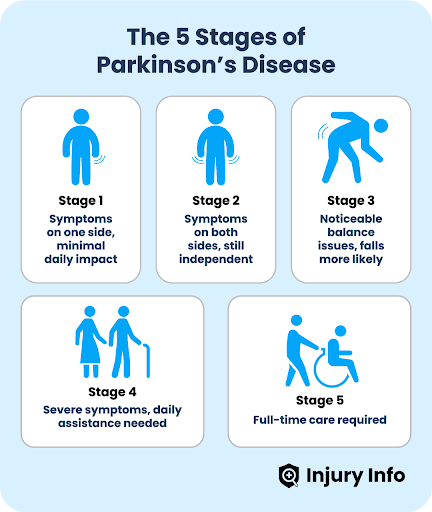
Stage 3 Parkinson’s is often thought of as the midpoint of the disease’s progression. Symptoms worsen, balance becomes harder to maintain, and the risk of falling increases. Your movements may be much slower, with frequent tremors. It’s harder to perform everyday tasks, like eating, getting dressed, and doing chores.
While medications can still be helpful at this stage, they’re sometimes not as effective at providing consistent symptom relief. Physical therapy and balance training for fall prevention can help you maintain as much independence and mobility as possible.
Patients in Stage 4 Parkinson’s disease typically deal with more severe mobility issues. It becomes difficult to live independently. Standing and walking are often very challenging, and balance issues make it unsafe to move without assistance.
Medications are still used at this stage, but their benefits may be limited. Mobility aids and a caregiver are commonly necessary to assist with daily living.
Stage 5 Parkinson’s is the most advanced stage of the disease, with many patients being unable to walk and needing a wheelchair. Beyond movement issues, you may experience mood disorders, confusion, hallucinations, or symptoms of dementia.
Medications continue, but treatment is more focused on your comfort and safety. Full-time care and supportive therapies can help you manage life at this stage. Palliative care may also be discussed to support quality of life and symptom relief.
Learn more about the potential connection between Parkinson’s disease and exposure to Paraquat:

If the disease is in an early stage, you’ll often be able to continue with your daily routine and hobbies. You may need to adjust your diet, sleep habits, and exercise. Your goal is to manage symptoms and preserve your mobility for long-term independence. With the right care plan, symptoms may be better managed over time.
Planning will help you move forward feeling confident. That means considering the costs of treatment and adjustments for living with Parkinson’s. Make a budget and take advantage of the financial resources that are available. A social worker or patient navigator can help identify programs and benefits.
Your mobility symptoms may be mild stiffness and light, occasional tremors that have a limited impact, or you could face difficulty with walking and balance that significantly limits what you’re able to do. Thinking ahead to prepare for mobility issues will help you plan adaptations that maximize your quality of life.
Take a look at your home and workplace and assess your daily routines. Think about which modifications make sense, like grab bars, railings, and ramps. You might even want to rearrange your home to make it easier for you to get around safely and independently.

Most people with a Parkinson’s disease diagnosis experience some trouble with movement. Here are the most common symptoms:
Adjusting to the limitations brought on by the disease means modifying your home or using adaptive tools to help you stay independent. You can have a better quality of life and live safely and comfortably.
Some ideas include:
The rate of progression for Parkinson’s disease varies. Some people live for years with only mild symptoms, while others experience a faster decline. Your overall health, symptom profile, and the care plan you follow all play a role in how the disease develops.
Yes, studies have reported an association between Paraquat exposure and Parkinson’s disease. Since there isn’t one single test for Parkinson’s, your doctor will consider your symptoms and also your medical history. Sharing exposure history helps your care team document risks and decide on appropriate evaluation.
Yes, lifestyle changes may help you manage your Parkinson’s symptoms and support overall well-being:
It’s important to note that none of these lifestyle changes is a cure that will stop the disease entirely. They can, however, complement medical care, improve quality of life, and help you maintain independence as safely as possible.

Learn what qualifies as a serious illness, key symptoms, and examples. Explore trusted legal and medical resources from Injury Info.

Learn how biomarkers aid in early cancer detection. Explore benefits, limitations, and examples used in ovarian cancer, mesothelioma, and lymphoma screening.

Learn what a cancer biopsy is, the different types, and why they're critical for diagnosing ovarian cancer, mesothelioma, and non-Hodgkin lymphoma accurately.
© 2026, Injury Info. All rights reserved.