
Ovarian cancer often carries the label “silent disease” because many of its early warning signs are subtle, vague, or easily mistaken for everyday conditions. This estrangement between symptom onset and recognition means the disease frequently advances before diagnosis. Understanding why this happens and what to watch for can make a meaningful difference for patients and their families.
Published on:
May 18, 2026
Category:
Ovarian Cancer

According to the Huntsman Cancer Institute, many women later diagnosed with ovarian cancer report symptoms that “seem like common stomach or bladder problems,” which makes them easy to overlook in the beginning. And without a reliable population-wide screening test, these symptoms play an important role in helping individuals recognize when something feels off.
Nonspecificity creates two key challenges: first, patients may delay seeking medical attention because they assume the symptoms are benign. Secondly, clinicians may misinterpret those symptoms or not recognise them as warning signs of ovarian cancer. For example, one survey found that 4 in 10 women felt their concerns were not taken seriously by a health professional.
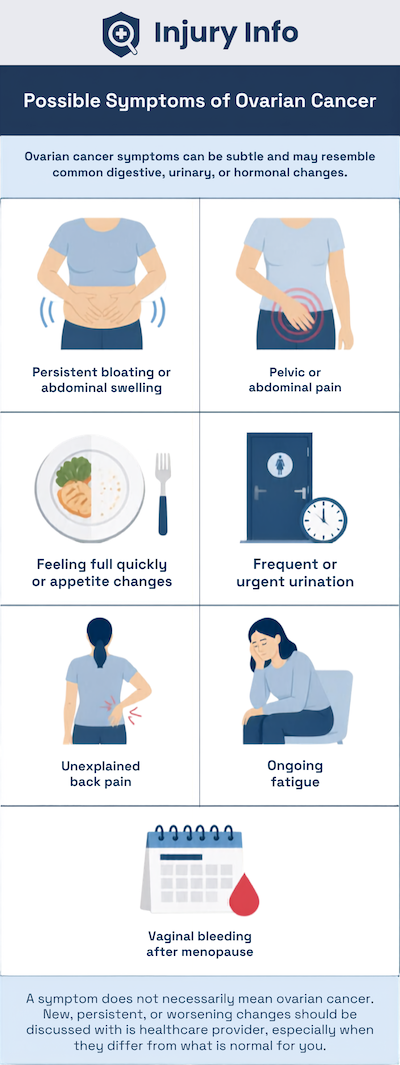
The symptoms listed below are reported in research and medical sources as being associated with ovarian cancer. However, they are not specific to the disease and can appear in non-cancer conditions as well.
More than 70% of women diagnosed with ovarian cancer reported persistent bloating that didn’t go away. While occasional bloating is common, the difference lies in its frequency, duration, and how it feels.
Pelvic or lower abdominal discomfort can occur when tumors or inflammation affect nearby tissues. Because this symptom overlaps with many benign conditions, it may be easy to overlook.
Some people report feeling full after eating only a small amount, a symptom that may develop gradually over time. The sensation of early satiety often accompanies bloating or abdominal pressure.
Needing to urinate more urgently or more often can occur when ovarian tumors press on the bladder. This symptom is common in non-cancer conditions, which can make it difficult to connect to ovarian health.
Unexplained lower back pain is sometimes reported in connection with ovarian cancer. Because back pain is widespread in daily life, it rarely prompts concern on its own.
Ongoing fatigue or low energy may appear as the body responds to internal changes. In many cases, fatigue is nonspecific and often attributed to stress, lifestyle, or anemia.
Unexpected bleeding after menopause can be a sign of several health conditions, including ovarian cancer. Even minor spotting may be noticeable because it differs from a person’s normal pattern.
Medical organizations, including the Ovarian Cancer Research Alliance and the Society of Gynecologic Oncology, emphasize that there is currently no effective general-population screening test for ovarian cancer. Because of this, awareness of symptom patterns plays an important role in helping individuals decide when to discuss new or persistent changes with a healthcare professional.
The World Ovarian Cancer Coalition reports that the average time from first symptom to diagnosis is nearly eight months, underscoring how easily early symptoms can be overlooked or attributed to other causes. These delays matter because ovarian cancer is more likely to be diagnosed at an advanced stage when symptoms become more pronounced. At later stages, the cancer may have already spread beyond the ovaries, which can influence treatment options and overall prognosis.
According to data from the American Cancer Society, the 5-year relative survival rate is approximately 92% when the cancer is found at a localized stage. However, this decreases to about 71% once it has spread to nearby tissues and to about 32% when it has metastasized to distant areas of the body. These differences reflect the significant role the extent of disease at diagnosis plays in shaping outcomes, which is why understanding and monitoring new or persistent symptoms can help support earlier conversations with a healthcare professional.
Because early symptoms are subtle, many people overlook them or attribute them to common daily issues. Paying attention to symptoms that persist, such as continued bloating, new pelvic pressure, or changes in appetite, may help individuals and families feel better equipped to discuss these changes with a healthcare professional.
It’s important to remember that symptom awareness does not mean expecting a serious diagnosis; rather, it’s about being familiar with your baseline and noticing when something shifts. Families can play a supportive role by noting symptom patterns, maintaining open communication, and tracking when changes begin or become more frequent. This kind of shared awareness can help individuals feel more confident bringing observations forward.
At Injury Info, we know that navigating a serious condition like ovarian cancer can leave individuals and families searching for answers on multiple levels: medical, legal, and financial. These areas are often interconnected, and understanding them together can facilitate a clearer path forward.
If you’re concerned that a delayed diagnosis, missed symptoms, or a medical decision may have affected your care, you’re not alone. We offer free, no-obligation case evaluations to help determine whether your experience may be linked to medical negligence, system failures, or other preventable factors.
Contact Injury Info today for a free case evaluation. Our team is here to help you understand your legal options so you can focus on your health and well-being.

Learn the main types of ovarian cancer and how they differ in origin, symptoms, and treatment to help patients and families understand their diagnosis.

Learn how digestive symptoms of ovarian cancer mimic common stomach issues, key differences to watch for, and when to seek medical evaluation.
© 2026, Injury Info. All rights reserved.