
The safety of talc as a consumer ingredient depends significantly on where it is mined and how thoroughly it is processed and tested. Asbestos, a known human carcinogen, may be present in the same rock formations where talc deposits form. Learning about the geological conditions that create this risk, the processing steps intended to address it, and the laboratory methods used to evaluate talc purity is essential context for anyone seeking to understand potential exposure concerns associated with talc-containing products.
Published on:
June 8, 2026
Category:
Health Resources
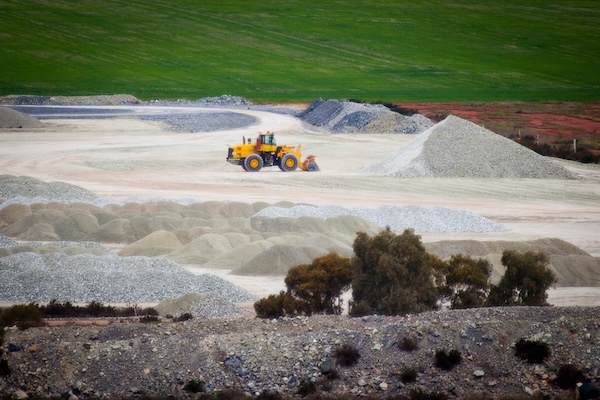
Talc is a soft, naturally occurring silicate mineral. It forms over millions of years through metamorphic geological processes, most commonly in environments where magnesium-rich rocks are transformed by heat and pressure.
Depending on the location and structure of a deposit, companies extract talc ore from either open-pit or underground mines. Once removed from the earth, raw talc ore is transported for processing, where it is crushed, milled, and sorted into different grades for different end uses.
The composition of the ore at the point of extraction varies widely depending on the geological environment, and because talc deposits are rarely found in complete mineral isolation, what comes out of the ground often contains other minerals alongside the talc itself.
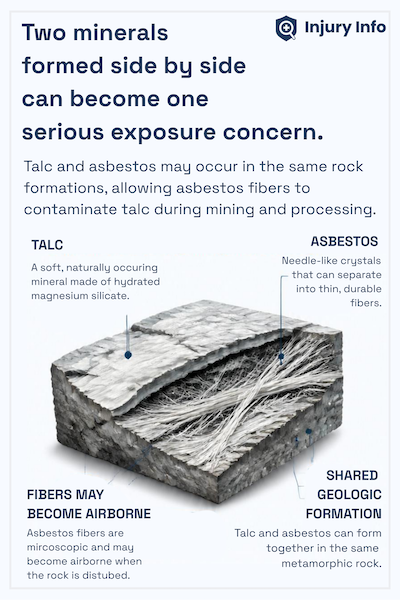
The talc formation process places talc deposits in close geological proximity to other minerals, some of which are benign, and some of which carry health implications. Of particular concern is the relationship between talc and asbestos, as talc is often found in underground deposits alongside asbestos ore.
Asbestos comprises six varieties of fibrous silicate minerals, and several share a geological origin with talc. As a result of the mining process, talc used in cosmetic products may contain asbestos fibers from minerals present near talc deposits. This is not a processing failure in every instance; it is a geological reality rooted in how both minerals form. Because of this, asbestos fibers can appear in talc deposits through natural mineral intergrowth, making rigorous testing vital for preventing exposure.
After extraction, talc ore undergoes several processing stages to improve its quality and consistency. Samples are taken and analyzed to evaluate chemical composition and identify contaminants before the material moves further through the supply chain. The challenge is that contamination is not always detectable through basic analysis.
The presence of asbestos found as a result of independent testing of talc-containing cosmetic products indicates that any asbestos present in talc ore is difficult to remove during processing. This means that even after conventional processing, trace contamination may persist, which is why testing at multiple stages of production, rather than relying solely on processing steps, is considered necessary.
Regulatory attention to talc purity has grown substantially in recent years, particularly for consumer products. The FDA has conducted repeated rounds of market testing for asbestos contamination in talc-containing cosmetic products. In 2019, the FDA tested 52 talc-containing cosmetic products and confirmed asbestos in 9 of them. The agency has continued testing in subsequent years, with results varying across product types and manufacturers.
The regulatory landscape for testing standards is still developing. In December 2024, the FDA proposed a rule that would have required manufacturers to test talc-containing cosmetics for asbestos using standardized methods. The FDA subsequently withdrew that proposed rule in November 2025, citing comments received during the public comment period that warranted further consideration.
The agency remains obligated under the Modernization of Cosmetics Regulation Act of 2022 to establish standardized testing requirements and has stated its intent to issue a new proposed rule. There is no established safe exposure threshold for asbestos, which underscores the continued importance of robust purity evaluation at both the deposit and product levels.
Advanced laboratory methods are the primary tool for detecting asbestos contamination in talc.
X-ray diffraction (XRD) has historically been used as an initial screening step, but XRD alone is not specific or sensitive enough to detect asbestos, leaving significant contamination undetected. For this reason, two additional techniques are considered essential. Polarized light microscopy (PLM) allows analysts to examine the physical structure of mineral particles and identify fibrous material consistent with asbestos. Transmission electron microscopy (TEM) combined with energy-dispersive spectroscopy and selected-area electron diffraction) provides a more detailed analysis of mineral composition at the atomic level and can detect contamination at trace concentrations that PLM alone may miss.
Using both methods in combination substantially improves the ability to detect contamination compared to relying on either technique alone, a principle that informed the FDA's proposed testing requirements and remains central to ongoing scientific and regulatory discussions about how best to protect consumers from asbestos exposure through talc-containing products.

For individuals concerned about the potential health implications of talc exposure, learning how contamination can occur is an important first step. To learn more, explore Injury Info resources on talc exposure, including potential health effects.

Experiencing unexplained vision problems? Learn the signs of meningioma brain tumors and when persistent symptoms require medical attention.

Paraquat and other herbicides require chemical-resistant gloves, respirators, eye protection, and other PPE. Learn when exposure risk is highest.
Learn how health agencies evaluate talc powder, what their classifications actually communicate, and why these findings matter in talc powder lawsuits.
© 2026, Injury Info. All rights reserved.