
Medical research is built on studying groups, not individuals, and that's not a limitation so much as a design choice with real scientific logic behind it. When a headline announces that a certain behavior "increases your risk" of a disease, it's drawing on population-level data that can identify patterns across thousands of people but cannot predict outcomes for any single individual. Understanding how that research works, and where it stops being useful, changes how you read those headlines.
Published on:
October 12, 2026
Category:
Health Resources
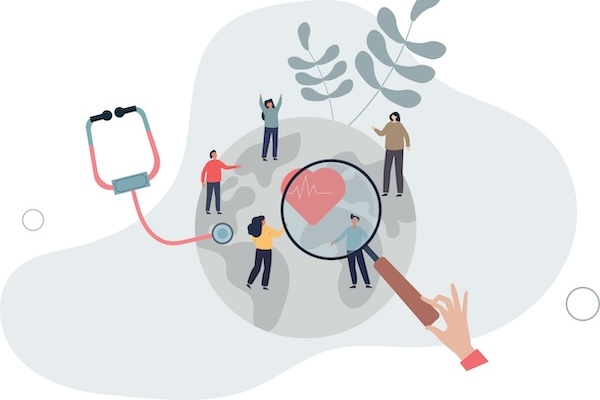
Epidemiology is the study of the distribution and determinants of health-related states or events in specified populations, and the application of that study to the control of health problems. Two essential concepts anchor the discipline: population and comparison. Rather than tracking a single patient, epidemiologists track patterns across large groups. By comparing those with and without a particular exposure, statistical associations can be identified with health outcomes.
Population health research uses several study designs. Cohort studies follow groups over time, classifying participants by exposure and observing who develops disease. Case-control studies start with people who have a condition and work backward to identify what factors were more common in their history. Cross-sectional studies capture a population snapshot at one point in time. Each design has strengths and trade-offs, and no single study type answers every question, but together they build an evidence base that moves from pattern to hypothesis to a better understanding of potential causal relationships.
Population health research produces rates and probabilities. These are statistical statements about what happens across groups. A finding that a particular exposure is associated with a 30 percent increase in relative risk means the exposed group developed an outcome 30 percent more often than the unexposed group across a large population. It does not mean any given individual will or won't experience that outcome.
Epidemiologists recognize that illness does not occur randomly; it happens when the right accumulation of risk factors exists in an individual. Each person brings a unique combination of genetics, environment, behavior, and medical history to any risk equation. A statistic derived from a general population may not apply to someone whose characteristics differ from those of the study group, which is why epidemiologic findings are intended to inform clinical decisions, not replace them.
The power of population health research lies in scale. Large studies detect associations invisible at the level of a single clinician's patient panel. One of the most influential cohort studies in medical history is the Framingham Heart Study. It has followed more than 5,000 Massachusetts residents since the early 1950s, generating foundational evidence on cardiovascular risk factors that now shapes clinical guidelines worldwide.
Scale also allows researchers to identify subgroups at elevated risk, which is essential for targeting interventions efficiently. By comparing disease rates across populations defined by time, place, and personal characteristics, researchers generate hypotheses about what drives disease, then test them with analytic studies designed to evaluate causation. Without population-level data, advances such as linking smoking to lung cancer or mapping infectious disease spread would not have been possible.
The most significant limitation of applying population data to individuals is the ecological fallacy, which is the error of assuming that relationships identified at the group level necessarily hold for individuals within that group. A study may find that counties with higher exposure rates also have higher disease rates, but it does not follow that most individuals with the disease within those counties were exposed, or that every exposed individual developed it.
Confounding is another key limitation. A statistical association between two variables may exist not because one causes the other, but because both are linked to a third unmeasured factor. Well-designed studies control for known confounders, but residual confounding remains a recognized limitation in observational research. Replication across multiple independent studies is the standard by which evidence is strengthened over time.
Despite its limitations, population health research is the foundation on which clinical guidelines, screening recommendations, and public health policy are built. When your doctor recommends a screening test or advises on risk reduction, her recommendations reflect accumulated population-level evidence about what improves outcomes across groups with similar characteristics.
The translation from population finding to individual clinical care is the clinician's task. She integrates research evidence with her patients' specific history, values, and circumstances. Research tells us what is generally true across populations; the physician's role is to determine what applies to a particular person. When you understand this distinction, it can help you ask not just "what does the research say?" but "how does it apply to someone like me?"
Population statistics are a starting point, not a verdict. If you're trying to apply research findings to your own health situation, the gap between those two things can feel significant. If you choose, you may visit InjuryInfo.com to explore general educational resources. Injury Info provides information only and does not offer medical advice. You may share information for a preliminary legal review. Legal consultations are free and carry no obligation. Contacting us does not create an attorney–client relationship. No outcome is guaranteed, and any matter requires case-by-case evaluation by licensed counsel or co-counsel.

Incorrect glucose readings may delay treatment or trigger dangerous responses. Learn how CGM devices measure blood sugar and what recent recalls may mean.

Not all medical test results give clear answers. Learn what inconclusive results mean, how doctors respond, and how to navigate uncertainty in your diagnosis.

Learn how asbestos exposure is documented using records, databases, and regulatory data, and why this information matters in health research.
© 2026, Injury Info. All rights reserved.